UI / UX Design
Limited time offers system
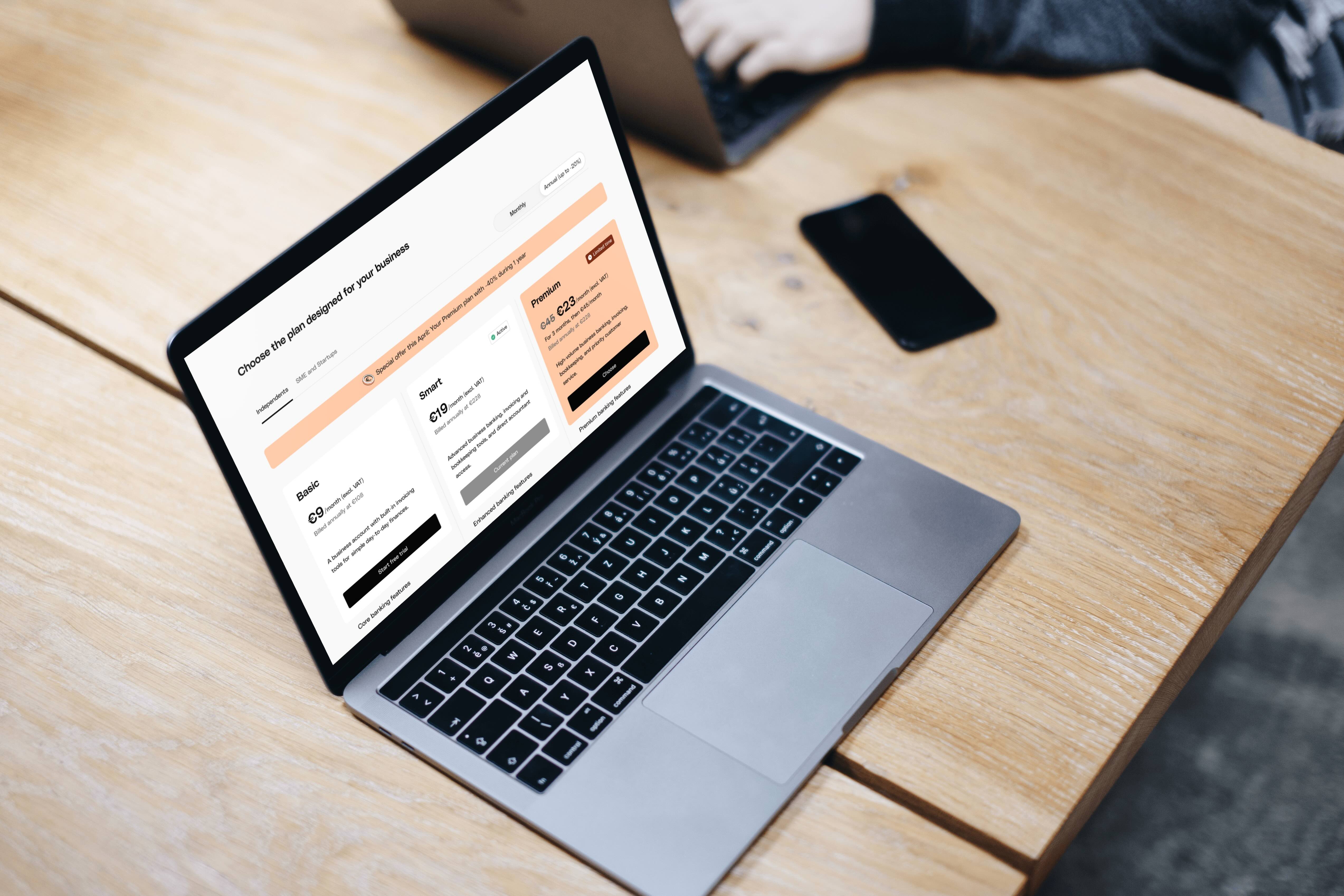
A systems design initiative that transformed promo campaign infrastructure from a hardcoded solution into a self-service platform. Delivered in two phases, this project empowered Growth team to independently launch, manage, and target promotional campaigns - reducing launch time by 95%
Year :
2025
Industry :
FinTech
Client :
Qonto
Project Duration :
6 months
Problem :
The Business Constraint
Qonto's pricing experimentation and promotional capabilities were severely limited by technical debt. Every promotional campaign required:
Feature flag implementation by developers & hardcoded frontend price displays
Manual pricing catalog updates
Full localization coordination across 8 EU markets
Result: The average campaign launch took 7-8 days and required cross-functional coordination across Engineering, Product, Marketing, and Localization teams.
Technical Debt Compounding User Experience Issues
The existing implementation created fundamental conflicts:
1. Free Trial Logic Conflicts
The system couldn't properly handle overlapping free trials and promotional periods. Pricing logic was hardcoded on the frontend, making it impossible to dynamically calculate correct pricing when these periods intersected.
2. Price Display Limitations
Qonto reserved strikethrough text formatting to show annual vs. monthly savings. This UX pattern constraint prevented the company from displaying promotional discounts with clear before/after pricing, limiting transparency and reducing promotional effectiveness.
3. Inconsistent Multi-touchpoint Experience
Promotional pricing appeared differently (or not at all) across:
Marketing website
Onboarding flows
In-app pricing pages
Add-on management screens
Checkout experiences
Invoicing
Email communications
Strategic Business Impact
Marketing and Growth teams couldn't execute:
Behavioral-triggered retention campaigns (e.g., churn prevention offers based on usage patterns)
Feature adoption incentives (e.g., discounted add-ons for specific plan tiers)
Lifecycle-based promotional strategies (e.g., anniversary discounts, reactivation campaigns)
A/B testing of promotional strategies without developer support
Partner integration promos for company creation flows
Organization list targeting for precision marketing campaigns
Solution :
Design Philosophy
Rather than optimizing the existing fragmented system, we designed a unified promotional architecture with three core principles:
Self-service by design – Marketing teams should configure campaigns without technical dependencies
Single source of truth – Backend-driven pricing logic eliminates frontend inconsistencies
Flexibility without complexity – Sophisticated targeting doesn't require sophisticated user interfaces
Phase 1: Foundation & Core Infrastructure (April - August 2025)
Core System Components:
1. Campaign Configurator
Built an admin interface in Qonto's internal tool enabling non-technical teams to create and manage campaigns through structured configuration:
Campaign Settings: Name, promoted product (plan/add-on), discount rates (monthly/annual), duration
Targeting Rules: Market selection (FR, DE, IT, ES, etc.), customer segments (new/existing), legal forms (GmbH, SA, SAS, etc.), current product holdings, billing recurrence
Time Management: Start/end dates with UTC timestamps, scheduling future campaigns
Campaign Priority System: Numerical ranking to resolve overlapping promotions
Content Management: Multi-language headline creation (8 EU languages) with 120-character limits
2. Backend Pricing Logic Redesign
Moved all promotional pricing calculation from frontend to backend via enhanced biller endpoints:
Discount Application Order: Standard price → Promotional discount → Vouchers (clear, predictable hierarchy)
Free Trial Handling: Automatic calculation of promotional period start based on trial end date
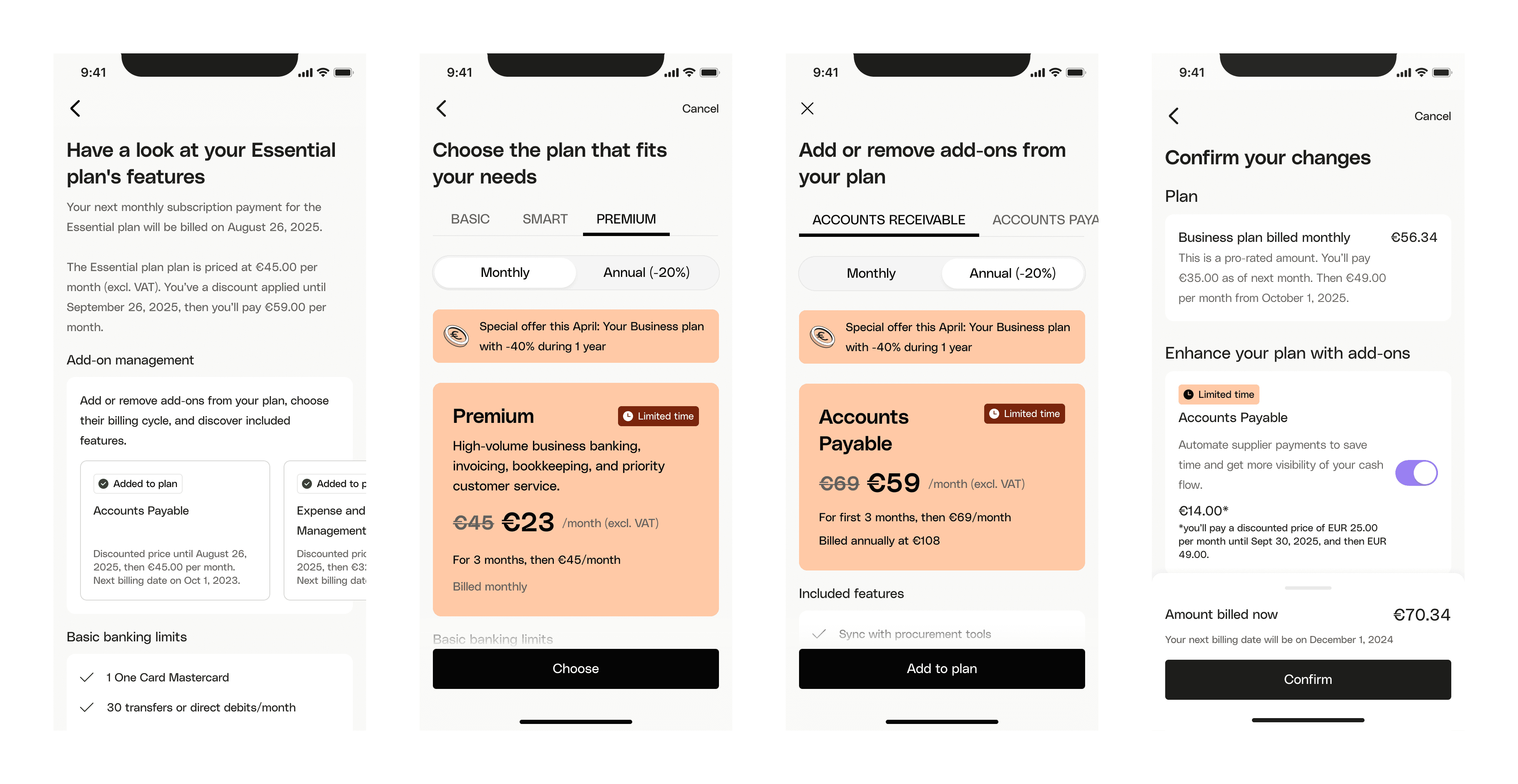
Prorated Pricing: Dynamic calculation for mid-cycle subscriptions
Edge Case Management: Plan changes during promos, product removals, recurrence switches
3. Multi-touchpoint UI Implementation
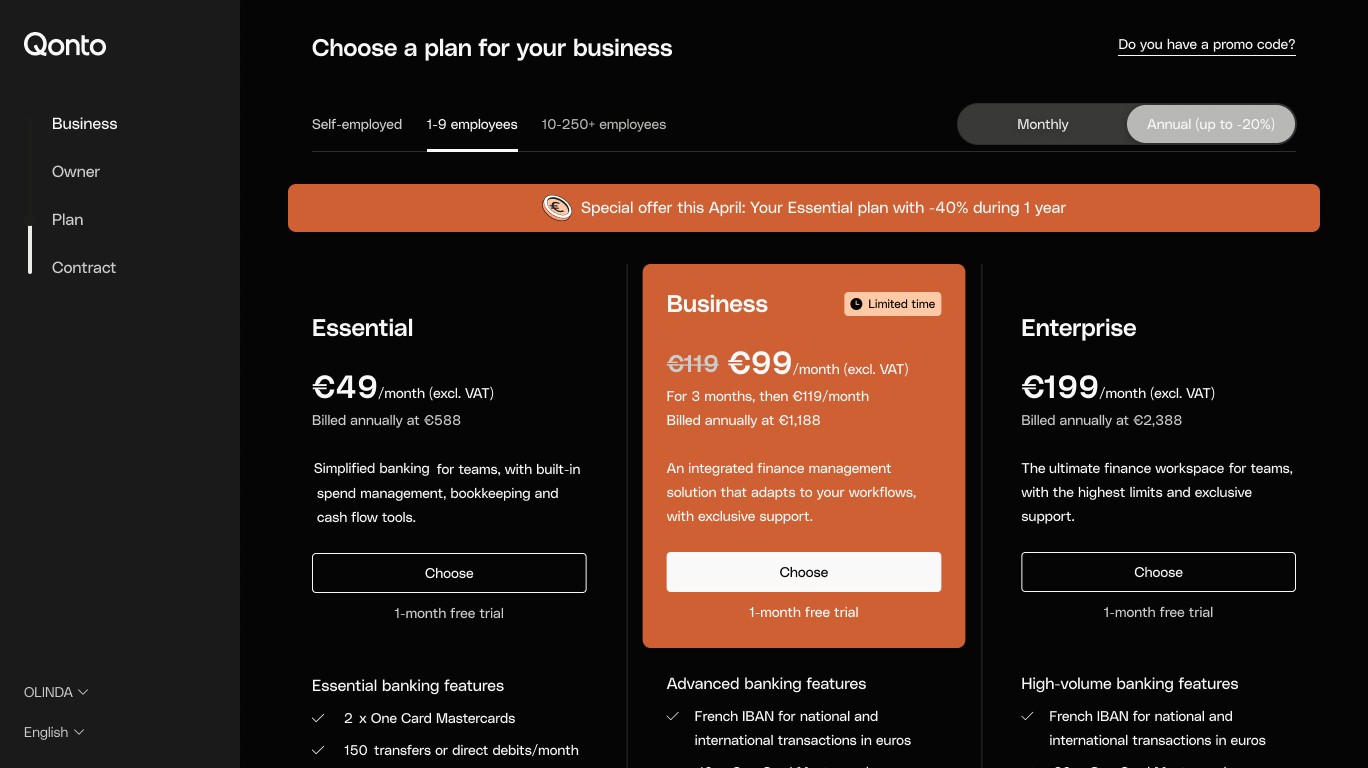
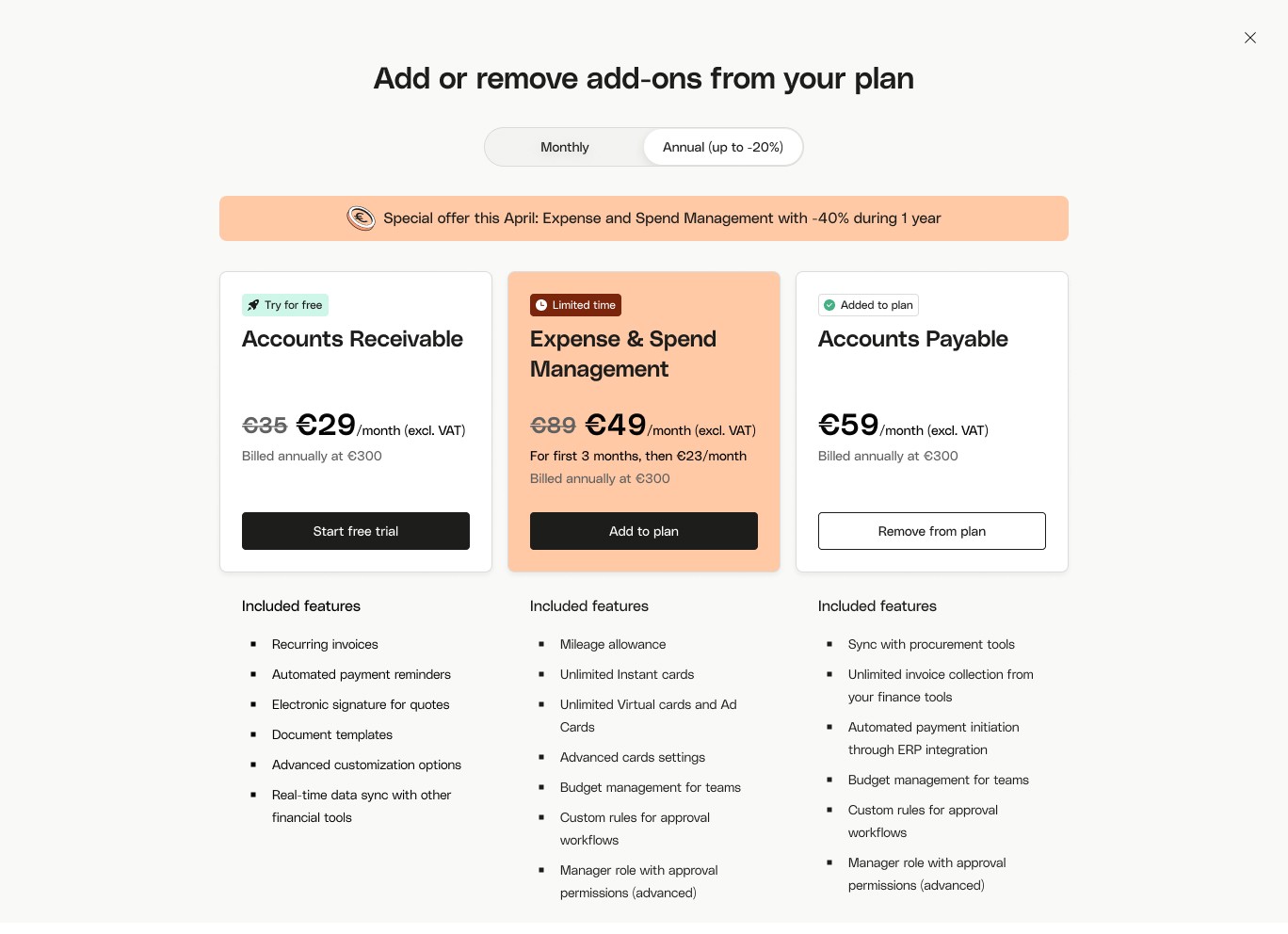
Designed consistent promotional displays across 6 key surfaces:
Surface | Key Elements | Display Logic |
|---|---|---|
Onboarding | Promo badge, headline, discounted pricing, duration, post-promo price | New customers, company creators |
Pricing Page | Limited-time badge, promotional price, regular price reference | Market + segment-based |
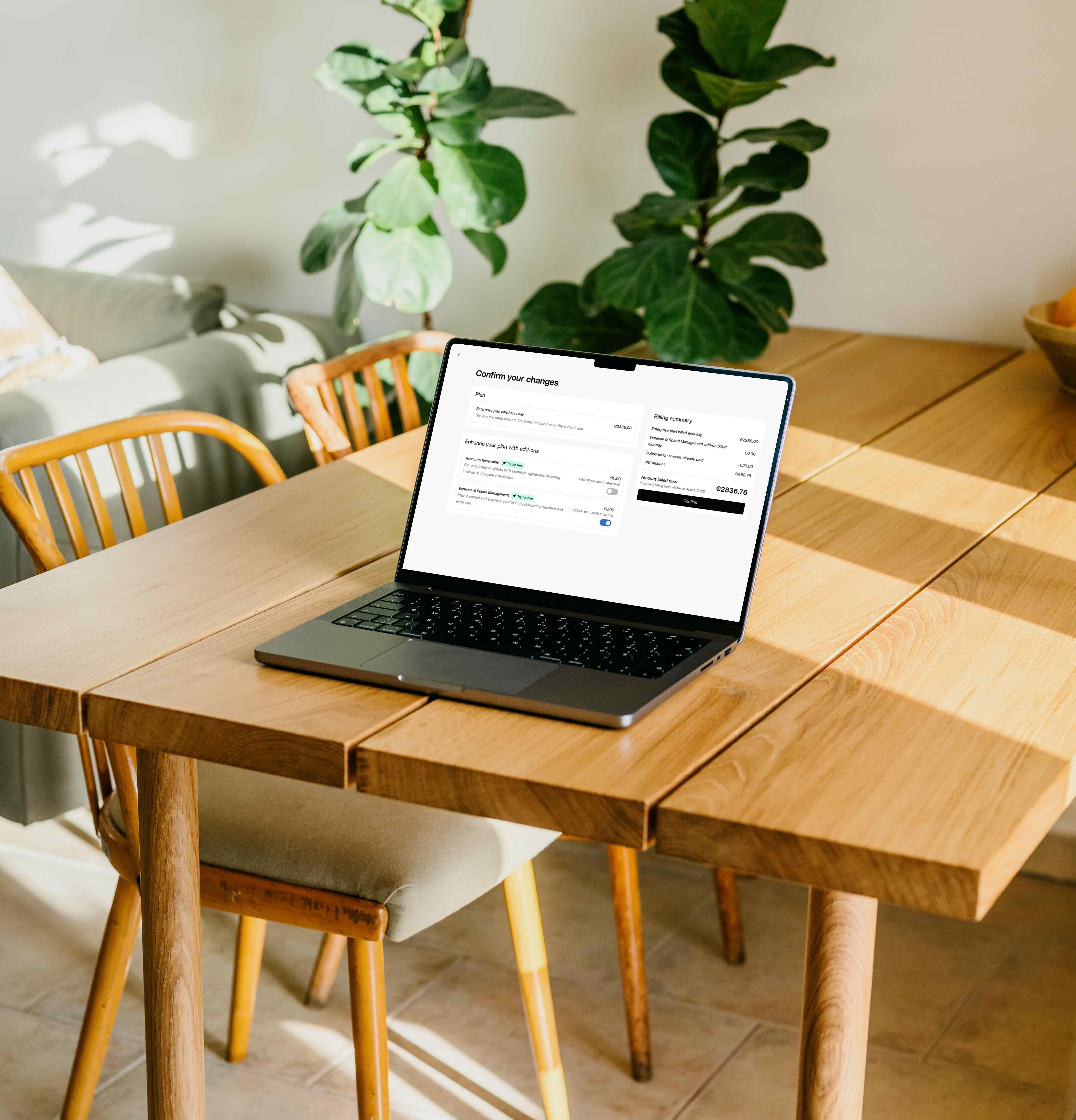
Add-on Management | "Try for free" vs promo badge hierarchy, clear pricing tiers | Existing customer eligibility |
Checkout | Price breakdown with separate discount line, prorated amounts, trial interactions | All eligible flows |
Invoicing | Separate promotional discount line item with VAT calculations | All invoices during promo period |
4. Complex Scenario Handling
Designed logic for 8 distinct pricing scenarios:
Free trial extending beyond promotion end
Free trial ending during active promotion
Active promotion without free trial (monthly/annual variations)
Standard pricing (control group)
Mid-promotion plan changes
Product removal and re-addition abuse prevention
Phase 2: Advanced Targeting & Flexibility (July - September 2025)
Strategic Additions:
1. Organization List Targeting
Enabled precision marketing through uploadable organization lists:
Use case: Growth team identifies churning customers through data analysis → uploads list → targets with retention offer
Benefit: Enables A/B testing without requiring feature flag access
Design consideration: Validation logic to check company lifecycle status and eligibility
2. Partner Flow Support
Extended promo system to company creation flows with partner integrations:
Supported partners: LegalPlace (FR), Beglaubigt.de (DE), Finutive (ES), Captain Contrat (FR), Norman (DE)
Challenge solved: Combined promotional pricing with partner fees and capital deposits
Design complexity: Each partner had different white-label UIs and payment flows requiring custom handling
3. Email Promotional Pricing Integration
Replaced generic "discount may apply" messaging with actual promotional prices:
Technical approach: Enhanced email templates with dynamic pricing data
User benefit: Clear expectations set before users begin checkout flow
4. Anti-abuse Protection
Designed "red bar" system preventing promotional gaming:
Problem: Customers removing/re-adding products to extend promotional periods
Solution: Promo cancellation on product removal with lockout until original promo end date
UX treatment: Visual indicator showing when promo can be reused
Design Decisions & Trade-offs
Decision: Use rate-based (percentage) discounts instead of fixed amounts
Rationale: Scales automatically when standard pricing changes; requires no campaign updates when plan prices are adjusted
Decision: Priority system instead of stacking logic for overlapping promos
Rationale: Simpler mental model for campaign creators; prevents unintended discount combinations that could harm revenue
Decision: "Try for free" badge takes precedence over promo badge
Rationale: Free trials convert better than discounts; avoid overwhelming users with multiple value propositions
Decision: Backend-driven pricing display
Rationale: Single source of truth eliminates frontend inconsistencies; enables real-time price updates without deployments
Delivery :
This project required coordination across:
Frontend Platforms:
Web application
iOS native app
Android native app
Onboarding flows
Cross-functional Orchestration
Phase 1 Stakeholders:
Product Design: Designed configurator UX, customer-facing promotional patterns, and multi-platform consistency
Product Management: Defined business logic, discount rules, and success criteria
Engineering: Backend, iOS, Android, Web teams
Content Design: Multi-language promotional messaging
Pricing CFT: Discount rate strategy and financial impact modeling
Phase 2 Additional Stakeholders:
Growth Team: Organization list targeting requirements and A/B test strategy
Email Team: Template updates for promotional pricing display
Key Delivery Milestones
Phase 1:
✅ Migrated all existing hardcoded promotions to new system (D+7)
✅ Launched Qonto's internal tool configurator with full access for Growth team
✅ Deployed consistent promo display across all 6 customer touchpoints
✅ Implemented invoice line item for promotional discounts
Phase 2:
✅ Launched organization list upload and targeting
✅ Enabled promo support for 5 partner company creation flows
✅ Updated email templates with dynamic promotional pricing
✅ Implemented anti-abuse red bar protection system
Success Analysis :
Primary Success Metric: Campaign Velocity
🎯 95% reduction in campaign launch time
Migration Success (D+7 Checkpoint)
✅ 100% of existing promotional campaigns successfully migrated from hardcoded implementations to the new self-service system within 7 days of Phase 1 launch.
System Adoption & Usage
D+30 Success Criteria: Marketing and Pricing teams can independently launch campaigns in <1 hour
Status: ✅ Achieved
Teams successfully launched campaigns without CFT Pricing involvement by D+30, confirming:
Configurator UX was intuitive enough for non-technical users
Documentation and training materials were sufficient
Backend validation caught configuration errors before launch
No emergency developer support requests post-launch
Business Impact Indicators
While direct revenue attribution is complex, the system enabled:
Campaign Flexibility:
Launch campaigns in 8 EU markets simultaneously
Target 10+ legal entity types independently
Configure dual recurrence pricing (monthly/annual) in a single campaign
Schedule future campaigns weeks in advance
Operational Efficiency:
Zero developer hours spent on routine campaign launches post-Phase 1
Marketing team freed from 2-week campaign planning cycles required for dev coordination
Eliminated localization bottlenecks via template-based headline system
Contribution to Design System
Created reusable promotional display patterns adopted across:
Pricing cards (badge hierarchy, strikethrough treatment)
Checkout price breakdowns (discount line item structure)
Email templates (dynamic pricing display logic)
Customer support tools (campaign visibility interface)
These patterns became part of Qonto's design system for future promotional features.
More Projects
UI / UX Design
Limited time offers system
A systems design initiative that transformed promo campaign infrastructure from a hardcoded solution into a self-service platform. Delivered in two phases, this project empowered Growth team to independently launch, manage, and target promotional campaigns - reducing launch time by 95%
Year :
2025
Industry :
FinTech
Client :
Qonto
Project Duration :
6 months
Problem :
The Business Constraint
Qonto's pricing experimentation and promotional capabilities were severely limited by technical debt. Every promotional campaign required:
Feature flag implementation by developers & hardcoded frontend price displays
Manual pricing catalog updates
Full localization coordination across 8 EU markets
Result: The average campaign launch took 7-8 days and required cross-functional coordination across Engineering, Product, Marketing, and Localization teams.
Technical Debt Compounding User Experience Issues
The existing implementation created fundamental conflicts:
1. Free Trial Logic Conflicts
The system couldn't properly handle overlapping free trials and promotional periods. Pricing logic was hardcoded on the frontend, making it impossible to dynamically calculate correct pricing when these periods intersected.
2. Price Display Limitations
Qonto reserved strikethrough text formatting to show annual vs. monthly savings. This UX pattern constraint prevented the company from displaying promotional discounts with clear before/after pricing, limiting transparency and reducing promotional effectiveness.
3. Inconsistent Multi-touchpoint Experience
Promotional pricing appeared differently (or not at all) across:
Marketing website
Onboarding flows
In-app pricing pages
Add-on management screens
Checkout experiences
Invoicing
Email communications
Strategic Business Impact
Marketing and Growth teams couldn't execute:
Behavioral-triggered retention campaigns (e.g., churn prevention offers based on usage patterns)
Feature adoption incentives (e.g., discounted add-ons for specific plan tiers)
Lifecycle-based promotional strategies (e.g., anniversary discounts, reactivation campaigns)
A/B testing of promotional strategies without developer support
Partner integration promos for company creation flows
Organization list targeting for precision marketing campaigns
Solution :
Design Philosophy
Rather than optimizing the existing fragmented system, we designed a unified promotional architecture with three core principles:
Self-service by design – Marketing teams should configure campaigns without technical dependencies
Single source of truth – Backend-driven pricing logic eliminates frontend inconsistencies
Flexibility without complexity – Sophisticated targeting doesn't require sophisticated user interfaces
Phase 1: Foundation & Core Infrastructure (April - August 2025)
Core System Components:
1. Campaign Configurator
Built an admin interface in Qonto's internal tool enabling non-technical teams to create and manage campaigns through structured configuration:
Campaign Settings: Name, promoted product (plan/add-on), discount rates (monthly/annual), duration
Targeting Rules: Market selection (FR, DE, IT, ES, etc.), customer segments (new/existing), legal forms (GmbH, SA, SAS, etc.), current product holdings, billing recurrence
Time Management: Start/end dates with UTC timestamps, scheduling future campaigns
Campaign Priority System: Numerical ranking to resolve overlapping promotions
Content Management: Multi-language headline creation (8 EU languages) with 120-character limits
2. Backend Pricing Logic Redesign
Moved all promotional pricing calculation from frontend to backend via enhanced biller endpoints:
Discount Application Order: Standard price → Promotional discount → Vouchers (clear, predictable hierarchy)
Free Trial Handling: Automatic calculation of promotional period start based on trial end date
Prorated Pricing: Dynamic calculation for mid-cycle subscriptions
Edge Case Management: Plan changes during promos, product removals, recurrence switches
3. Multi-touchpoint UI Implementation
Designed consistent promotional displays across 6 key surfaces:
Surface | Key Elements | Display Logic |
|---|---|---|
Onboarding | Promo badge, headline, discounted pricing, duration, post-promo price | New customers, company creators |
Pricing Page | Limited-time badge, promotional price, regular price reference | Market + segment-based |
Add-on Management | "Try for free" vs promo badge hierarchy, clear pricing tiers | Existing customer eligibility |
Checkout | Price breakdown with separate discount line, prorated amounts, trial interactions | All eligible flows |
Invoicing | Separate promotional discount line item with VAT calculations | All invoices during promo period |
4. Complex Scenario Handling
Designed logic for 8 distinct pricing scenarios:
Free trial extending beyond promotion end
Free trial ending during active promotion
Active promotion without free trial (monthly/annual variations)
Standard pricing (control group)
Mid-promotion plan changes
Product removal and re-addition abuse prevention
Phase 2: Advanced Targeting & Flexibility (July - September 2025)
Strategic Additions:
1. Organization List Targeting
Enabled precision marketing through uploadable organization lists:
Use case: Growth team identifies churning customers through data analysis → uploads list → targets with retention offer
Benefit: Enables A/B testing without requiring feature flag access
Design consideration: Validation logic to check company lifecycle status and eligibility
2. Partner Flow Support
Extended promo system to company creation flows with partner integrations:
Supported partners: LegalPlace (FR), Beglaubigt.de (DE), Finutive (ES), Captain Contrat (FR), Norman (DE)
Challenge solved: Combined promotional pricing with partner fees and capital deposits
Design complexity: Each partner had different white-label UIs and payment flows requiring custom handling
3. Email Promotional Pricing Integration
Replaced generic "discount may apply" messaging with actual promotional prices:
Technical approach: Enhanced email templates with dynamic pricing data
User benefit: Clear expectations set before users begin checkout flow
4. Anti-abuse Protection
Designed "red bar" system preventing promotional gaming:
Problem: Customers removing/re-adding products to extend promotional periods
Solution: Promo cancellation on product removal with lockout until original promo end date
UX treatment: Visual indicator showing when promo can be reused
Design Decisions & Trade-offs
Decision: Use rate-based (percentage) discounts instead of fixed amounts
Rationale: Scales automatically when standard pricing changes; requires no campaign updates when plan prices are adjusted
Decision: Priority system instead of stacking logic for overlapping promos
Rationale: Simpler mental model for campaign creators; prevents unintended discount combinations that could harm revenue
Decision: "Try for free" badge takes precedence over promo badge
Rationale: Free trials convert better than discounts; avoid overwhelming users with multiple value propositions
Decision: Backend-driven pricing display
Rationale: Single source of truth eliminates frontend inconsistencies; enables real-time price updates without deployments
Delivery :
This project required coordination across:
Frontend Platforms:
Web application
iOS native app
Android native app
Onboarding flows
Cross-functional Orchestration
Phase 1 Stakeholders:
Product Design: Designed configurator UX, customer-facing promotional patterns, and multi-platform consistency
Product Management: Defined business logic, discount rules, and success criteria
Engineering: Backend, iOS, Android, Web teams
Content Design: Multi-language promotional messaging
Pricing CFT: Discount rate strategy and financial impact modeling
Phase 2 Additional Stakeholders:
Growth Team: Organization list targeting requirements and A/B test strategy
Email Team: Template updates for promotional pricing display
Key Delivery Milestones
Phase 1:
✅ Migrated all existing hardcoded promotions to new system (D+7)
✅ Launched Qonto's internal tool configurator with full access for Growth team
✅ Deployed consistent promo display across all 6 customer touchpoints
✅ Implemented invoice line item for promotional discounts
Phase 2:
✅ Launched organization list upload and targeting
✅ Enabled promo support for 5 partner company creation flows
✅ Updated email templates with dynamic promotional pricing
✅ Implemented anti-abuse red bar protection system
Success Analysis :
Primary Success Metric: Campaign Velocity
🎯 95% reduction in campaign launch time
Migration Success (D+7 Checkpoint)
✅ 100% of existing promotional campaigns successfully migrated from hardcoded implementations to the new self-service system within 7 days of Phase 1 launch.
System Adoption & Usage
D+30 Success Criteria: Marketing and Pricing teams can independently launch campaigns in <1 hour
Status: ✅ Achieved
Teams successfully launched campaigns without CFT Pricing involvement by D+30, confirming:
Configurator UX was intuitive enough for non-technical users
Documentation and training materials were sufficient
Backend validation caught configuration errors before launch
No emergency developer support requests post-launch
Business Impact Indicators
While direct revenue attribution is complex, the system enabled:
Campaign Flexibility:
Launch campaigns in 8 EU markets simultaneously
Target 10+ legal entity types independently
Configure dual recurrence pricing (monthly/annual) in a single campaign
Schedule future campaigns weeks in advance
Operational Efficiency:
Zero developer hours spent on routine campaign launches post-Phase 1
Marketing team freed from 2-week campaign planning cycles required for dev coordination
Eliminated localization bottlenecks via template-based headline system
Contribution to Design System
Created reusable promotional display patterns adopted across:
Pricing cards (badge hierarchy, strikethrough treatment)
Checkout price breakdowns (discount line item structure)
Email templates (dynamic pricing display logic)
Customer support tools (campaign visibility interface)
These patterns became part of Qonto's design system for future promotional features.
More Projects
UI / UX Design
Limited time offers system
A systems design initiative that transformed promo campaign infrastructure from a hardcoded solution into a self-service platform. Delivered in two phases, this project empowered Growth team to independently launch, manage, and target promotional campaigns - reducing launch time by 95%
Year :
2025
Industry :
FinTech
Client :
Qonto
Project Duration :
6 months
Problem :
The Business Constraint
Qonto's pricing experimentation and promotional capabilities were severely limited by technical debt. Every promotional campaign required:
Feature flag implementation by developers & hardcoded frontend price displays
Manual pricing catalog updates
Full localization coordination across 8 EU markets
Result: The average campaign launch took 7-8 days and required cross-functional coordination across Engineering, Product, Marketing, and Localization teams.
Technical Debt Compounding User Experience Issues
The existing implementation created fundamental conflicts:
1. Free Trial Logic Conflicts
The system couldn't properly handle overlapping free trials and promotional periods. Pricing logic was hardcoded on the frontend, making it impossible to dynamically calculate correct pricing when these periods intersected.
2. Price Display Limitations
Qonto reserved strikethrough text formatting to show annual vs. monthly savings. This UX pattern constraint prevented the company from displaying promotional discounts with clear before/after pricing, limiting transparency and reducing promotional effectiveness.
3. Inconsistent Multi-touchpoint Experience
Promotional pricing appeared differently (or not at all) across:
Marketing website
Onboarding flows
In-app pricing pages
Add-on management screens
Checkout experiences
Invoicing
Email communications
Strategic Business Impact
Marketing and Growth teams couldn't execute:
Behavioral-triggered retention campaigns (e.g., churn prevention offers based on usage patterns)
Feature adoption incentives (e.g., discounted add-ons for specific plan tiers)
Lifecycle-based promotional strategies (e.g., anniversary discounts, reactivation campaigns)
A/B testing of promotional strategies without developer support
Partner integration promos for company creation flows
Organization list targeting for precision marketing campaigns
Solution :
Design Philosophy
Rather than optimizing the existing fragmented system, we designed a unified promotional architecture with three core principles:
Self-service by design – Marketing teams should configure campaigns without technical dependencies
Single source of truth – Backend-driven pricing logic eliminates frontend inconsistencies
Flexibility without complexity – Sophisticated targeting doesn't require sophisticated user interfaces
Phase 1: Foundation & Core Infrastructure (April - August 2025)
Core System Components:
1. Campaign Configurator
Built an admin interface in Qonto's internal tool enabling non-technical teams to create and manage campaigns through structured configuration:
Campaign Settings: Name, promoted product (plan/add-on), discount rates (monthly/annual), duration
Targeting Rules: Market selection (FR, DE, IT, ES, etc.), customer segments (new/existing), legal forms (GmbH, SA, SAS, etc.), current product holdings, billing recurrence
Time Management: Start/end dates with UTC timestamps, scheduling future campaigns
Campaign Priority System: Numerical ranking to resolve overlapping promotions
Content Management: Multi-language headline creation (8 EU languages) with 120-character limits
2. Backend Pricing Logic Redesign
Moved all promotional pricing calculation from frontend to backend via enhanced biller endpoints:
Discount Application Order: Standard price → Promotional discount → Vouchers (clear, predictable hierarchy)
Free Trial Handling: Automatic calculation of promotional period start based on trial end date
Prorated Pricing: Dynamic calculation for mid-cycle subscriptions
Edge Case Management: Plan changes during promos, product removals, recurrence switches
3. Multi-touchpoint UI Implementation
Designed consistent promotional displays across 6 key surfaces:
Surface | Key Elements | Display Logic |
|---|---|---|
Onboarding | Promo badge, headline, discounted pricing, duration, post-promo price | New customers, company creators |
Pricing Page | Limited-time badge, promotional price, regular price reference | Market + segment-based |
Add-on Management | "Try for free" vs promo badge hierarchy, clear pricing tiers | Existing customer eligibility |
Checkout | Price breakdown with separate discount line, prorated amounts, trial interactions | All eligible flows |
Invoicing | Separate promotional discount line item with VAT calculations | All invoices during promo period |
4. Complex Scenario Handling
Designed logic for 8 distinct pricing scenarios:
Free trial extending beyond promotion end
Free trial ending during active promotion
Active promotion without free trial (monthly/annual variations)
Standard pricing (control group)
Mid-promotion plan changes
Product removal and re-addition abuse prevention
Phase 2: Advanced Targeting & Flexibility (July - September 2025)
Strategic Additions:
1. Organization List Targeting
Enabled precision marketing through uploadable organization lists:
Use case: Growth team identifies churning customers through data analysis → uploads list → targets with retention offer
Benefit: Enables A/B testing without requiring feature flag access
Design consideration: Validation logic to check company lifecycle status and eligibility
2. Partner Flow Support
Extended promo system to company creation flows with partner integrations:
Supported partners: LegalPlace (FR), Beglaubigt.de (DE), Finutive (ES), Captain Contrat (FR), Norman (DE)
Challenge solved: Combined promotional pricing with partner fees and capital deposits
Design complexity: Each partner had different white-label UIs and payment flows requiring custom handling
3. Email Promotional Pricing Integration
Replaced generic "discount may apply" messaging with actual promotional prices:
Technical approach: Enhanced email templates with dynamic pricing data
User benefit: Clear expectations set before users begin checkout flow
4. Anti-abuse Protection
Designed "red bar" system preventing promotional gaming:
Problem: Customers removing/re-adding products to extend promotional periods
Solution: Promo cancellation on product removal with lockout until original promo end date
UX treatment: Visual indicator showing when promo can be reused
Design Decisions & Trade-offs
Decision: Use rate-based (percentage) discounts instead of fixed amounts
Rationale: Scales automatically when standard pricing changes; requires no campaign updates when plan prices are adjusted
Decision: Priority system instead of stacking logic for overlapping promos
Rationale: Simpler mental model for campaign creators; prevents unintended discount combinations that could harm revenue
Decision: "Try for free" badge takes precedence over promo badge
Rationale: Free trials convert better than discounts; avoid overwhelming users with multiple value propositions
Decision: Backend-driven pricing display
Rationale: Single source of truth eliminates frontend inconsistencies; enables real-time price updates without deployments
Delivery :
This project required coordination across:
Frontend Platforms:
Web application
iOS native app
Android native app
Onboarding flows
Cross-functional Orchestration
Phase 1 Stakeholders:
Product Design: Designed configurator UX, customer-facing promotional patterns, and multi-platform consistency
Product Management: Defined business logic, discount rules, and success criteria
Engineering: Backend, iOS, Android, Web teams
Content Design: Multi-language promotional messaging
Pricing CFT: Discount rate strategy and financial impact modeling
Phase 2 Additional Stakeholders:
Growth Team: Organization list targeting requirements and A/B test strategy
Email Team: Template updates for promotional pricing display
Key Delivery Milestones
Phase 1:
✅ Migrated all existing hardcoded promotions to new system (D+7)
✅ Launched Qonto's internal tool configurator with full access for Growth team
✅ Deployed consistent promo display across all 6 customer touchpoints
✅ Implemented invoice line item for promotional discounts
Phase 2:
✅ Launched organization list upload and targeting
✅ Enabled promo support for 5 partner company creation flows
✅ Updated email templates with dynamic promotional pricing
✅ Implemented anti-abuse red bar protection system
Success Analysis :
Primary Success Metric: Campaign Velocity
🎯 95% reduction in campaign launch time
Migration Success (D+7 Checkpoint)
✅ 100% of existing promotional campaigns successfully migrated from hardcoded implementations to the new self-service system within 7 days of Phase 1 launch.
System Adoption & Usage
D+30 Success Criteria: Marketing and Pricing teams can independently launch campaigns in <1 hour
Status: ✅ Achieved
Teams successfully launched campaigns without CFT Pricing involvement by D+30, confirming:
Configurator UX was intuitive enough for non-technical users
Documentation and training materials were sufficient
Backend validation caught configuration errors before launch
No emergency developer support requests post-launch
Business Impact Indicators
While direct revenue attribution is complex, the system enabled:
Campaign Flexibility:
Launch campaigns in 8 EU markets simultaneously
Target 10+ legal entity types independently
Configure dual recurrence pricing (monthly/annual) in a single campaign
Schedule future campaigns weeks in advance
Operational Efficiency:
Zero developer hours spent on routine campaign launches post-Phase 1
Marketing team freed from 2-week campaign planning cycles required for dev coordination
Eliminated localization bottlenecks via template-based headline system
Contribution to Design System
Created reusable promotional display patterns adopted across:
Pricing cards (badge hierarchy, strikethrough treatment)
Checkout price breakdowns (discount line item structure)
Email templates (dynamic pricing display logic)
Customer support tools (campaign visibility interface)
These patterns became part of Qonto's design system for future promotional features.